Your code and your art live in your repo — versioned, backed up, owned. Your plan lives in someone else’s cloud. The two drift apart a little more every day, and every so often the gap between them costs you a morning.
Two sources of truth, quietly disagreeing
When the plan lives in a hosted tracker and the work lives in your repo, they’re never quite in step. You branch a feature, but the tasks don’t branch with it. You roll a build back to last week, but the board still shows this week’s plan. A studio drops offline for an afternoon and nobody can even see what they were meant to be doing.
Underneath it all is the question studios increasingly stop to ask: whose data is this, really — and what happens to it if the service changes its terms, its price, or its mind?
Tasks are just assets in your project
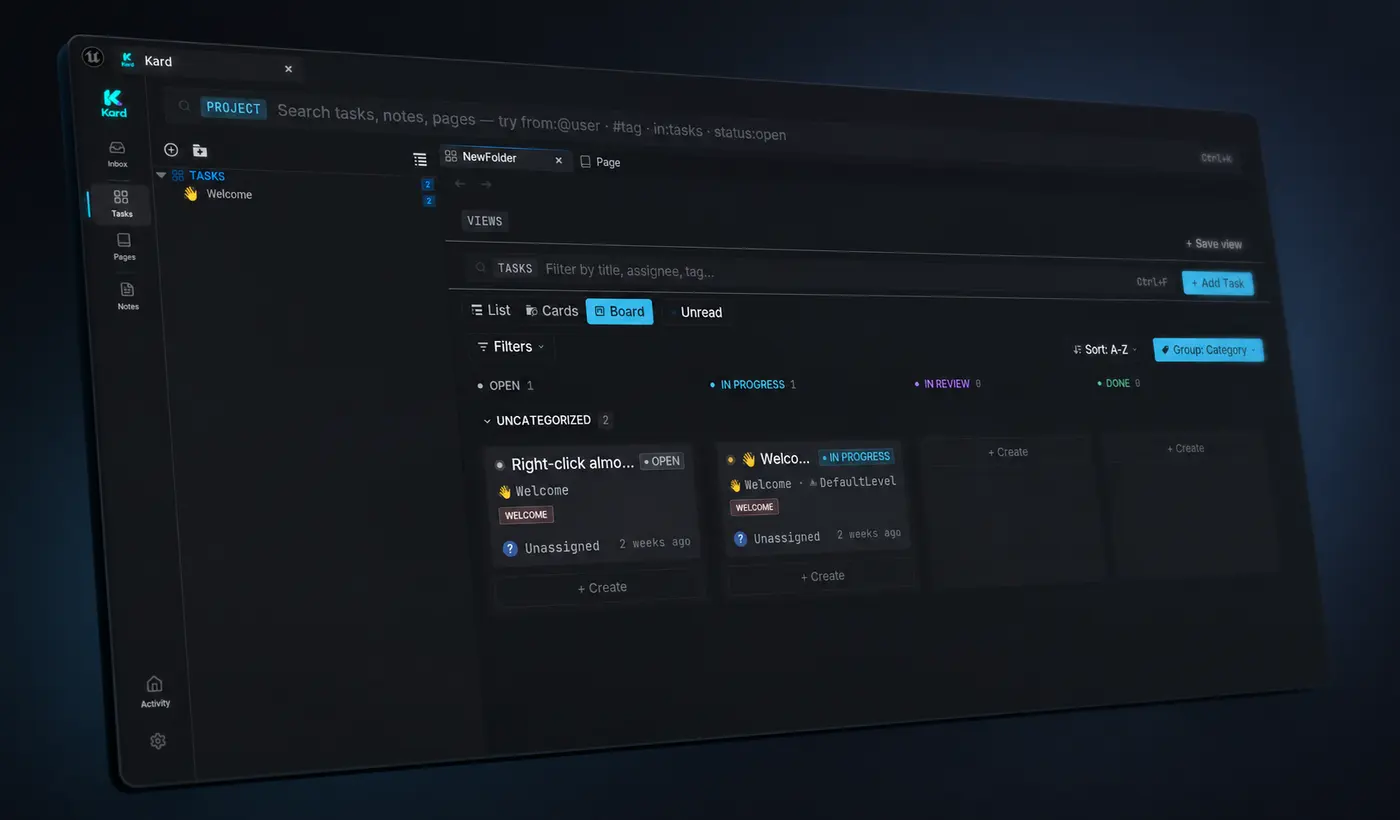
Kard takes the opposite approach. Every Kard — task, note, or page — is a standard .uasset in your project’s Content folder, the same kind of file as a material or a level. That one decision changes everything downstream:
- It checks out and commits like any other asset, through the workflow you already use.
- It branches and merges with the code and content it belongs to. The plan can’t fall out of step with the build, because it’s inside the build.
- It’s yours — backed up wherever your project is backed up, with no export step and nothing to reclaim from anyone.
Kard is built around this, not bolted onto it. Each card is its own file, and every deletion writes a tiny separate record — so two people removing cards on different branches don’t collide. Card history is capped so a busy task never turns into an expensive checkout. It’s designed to be a good citizen in a depot or a repo, with a dedicated [Kard] changelist on Perforce and commit linking on Git.
The plan can’t drift from the build, because it is part of the build.
Local-first, by default
Out of the box, nothing leaves your machine. There’s no account to create, no server to run, no sync to configure — the shipping default keeps everything on disk as project assets, and the plugin makes no network calls until you ask it to.
A hosted backend exists for studios that specifically want one, but it’s off by default and you never have to think about it. The two AI features — an assistant you bring your own key for, and a local automation server — are likewise off until you switch them on, and even then the automation server only ever listens on your own machine.
The tracker that respects your pipeline
You already have a system for versioning, backing up, and sharing your project. Kard’s whole premise is to put your plan inside that system, instead of asking you to run a second one alongside it.
Free for solo developers and small teams, installed into your project, versioned with everything else. The plan stops being a thing you sync, and becomes a thing you simply have.